YUQI WANG: PORTRAIT OF A PORTRAITIST
JANUARY/FEBRUARY 2019 – FINEARTCONNOISSEUR.COM – BY DAVID MASELLO
Yuqi Wang (b. 1958) is looking for the right word. A vintage recording of the great tenor Franco Corelli singing Neapolitan love songs is playing on the phonograph in his Red Hook (Brooklyn) studio, a quiet, contemplative space shot through with beams of sunlight from the west. “In my portraits, I try to capture something spiritual about the people, their humanity, their interiors – but those are still not the right words I’m after to describe what I want to do as a portrait painter.” Wang says while pointing to various canvases. Although born and raised in China, Yuqi (pronounced “Yoo-chee”) Wang speaks English fluently, albeit with an accent, but to that precise word for his intention, he consults an online Chinese-to-English dictionary.
“Ah, here it is,” he says, holding out the iPhone to show the answer that appears in both English and Chinese characters. “‘Dignity,’ that’s what I want to achieve with everyone who sits for me. Their dignity.”
To look at the many painted faces and figures on the walls and easels of Wang’s loft-like studio is to see the inherent dignity of the men and women he has chosen to depict. Some of the figures are clothed, others are not, and while most are physically beautiful, some wear their years a bit more frankly. Given the way Wang characterizes his subjects, it is not surprising that he cites Rembrandt as among his most important influences.
“Rembrandt tried searching for what was inside a person and putting that on the canvas,’ Wang says. “He painted people, yes. But he didn’t always seek out pretty faces or prettily shaped bodies. His figures appear like lighthouses on the sea. You see the real person. The first time I saw Rembrandt paintings, in an art history book as a boy in china, I was very touched. I didn’t recognize the faces he painted as being Western art or Eastern art. They were human faces. That’s what mattered to me.”
Wang came of age as China was convulsed by Mao’s so-called Cultural Revolution, which forced people to shun all things Western, be they political or aesthetic. It wasn’t until Wang was 10 or 11 years old that he saw his first example of true Western art – a black-and-white image in an old newspaper hanging in someone’s window as a makeshift curtain. He remembers stopping to stare at the image of the figure with long hair and an enigmatic expression. It was Leonardo’s Mona Lisa. “I had no concept of what was or wasn’t Western art at that time, but I couldn’t stop looking, even though the face was a little scary to me.”
Later, in high school, he saw more examples of Western art in textbooks and art magazines. Those images, coupled with a truly revolutionary exhibition of paintings loaned by French museums and mounted in Beijing in the late 1970s, provided Wang with a firm context for the subject matter that has propelled him forward ever since. He cites Chardin, Millet, Waterhouse, Moreau, the Barbizon School, and Courbet as among the artists and movements that helped forge his artistic identity. “Even today, I keep thinking of the Pre-Raphaelite artists and how powerful it was for me to see their works, especially the red-haired woman in the boat in Waterhouse’s The Lady of Shalott,” he says, referring to the legendary figure who died of unrequited love.
AN EARLY REVOLUTIONARY
Today Wang is one of the world’s acknowledged masters of portraiture, having won prizes and notable commissions, including a grand prize and first place prize from the Portrait Society of America, and a second prize in the National Portrait Gallery Outwin Boochever competition.
Yet the portraiture for which Wang is famous is not actually the genre he pursued as a young artist. When he attended the Academy of Fine Art in his home city of Tianjin, he was assigned to learn printmaking. “In those days, what you were assigned to study in art school was what you had to study for the four years until graduation. There was no breaking of rules. I was warned that if I kept trying to make oil paintings, which is what I wanted to do, I wouldn’t get my certificate at the end.”
In true revolutionary spirit, however, the precocious Wang defied the authorities. For his graduate thesis, he produced a series of paintings depicting Chinese country life, an echo, in many ways, of the 19th-century French pastoral scenes he had recently come upon an admired. “I must admit, I became a kind of star on campus,” he recalls.
Later, Wang attended Beijing’s Central Academy of Fine Art, where he was finally able to experience the thrill and methodology of painting live models, the technique he continues to use whenever possible. There, renouncing the color palette, notably garish reds, that had been promoted by Communist authorities, Wang painted a poignant scene depicting two farmers – a man and a woman just in from the field, dirty and exhausted but inherently noble – a work that earned him a prize. “That painting was dark and its colors muted; it was realistic in ways that paintings in China had not been for many years.”
In keeping with his passion for depicting real people doing real things, Wang later embarked on a five-part series of paintings of a woman. “I remember as a young kid attending a funeral and I saw a girl there in a dress with a white collar. The sight of her and what she was wearing, both on her and the expression she wore on her face really touched and moved me.” It was from that memory that Wang produced the canvases that traed the complete life of a woman, from girlhood to old age.
From the time he was a boy drawing anything and everything to when he became a student and, later, a teacher, Wang learned the importance of cultivating the right subjects. To be a good – now a great – portraitist requires the earning of trust. The sitter needs to trust the artist for whom he or she sits, often for weeks at a time. It also requires a special vision on the artist’s part – the ability to see into a person.
“As a boy, I taught myself to draw as a way to protect my dignity during the disastrous years of the Cultural Revolution.” Wang explains. “I purposely sought out people I knew would be friendly, willing to let me draw and paint them. My first models were family members, neighbors, and classmates.”
Although China had become a very different place by the mid-1990s, Wang was eager to begin a new metaphorical canvas in his life. Chinese friends had already settled in Chicago encouraged him to come there. “There were four reasons I decided to go to Chicago,” Wang recalls. “One was that I had seen in Paris some of Gustave Moreau’s mythological scenes, and I was especially intent on seeing Hercules and the Lernaean Hydra in the permanent collection of the Art Institute of Chicago. I also wanted to see Sir Georg Solti conduct the Chicago Symphony Orchestra, to watch Michael Jordan play basketball, and, maybe, the fourth reason, to see where the Mafia once had so much power.” While Chicago proved to be the right portal to life in America, Wang continued to feel the pull of New York City, eventually relocating there, where he remains, shuttling daily between his Brooklyn apartment and his studio nearby.
Wang remembers his first tour through the rough-and-tumble, post-industrial landscape of Red Hook; he had heard that the light there – and the low rents – were ideal for artists. “The landlord took me up to the roof of this building, and when I saw the 360-degree views from up there – of Brooklyn, Manhattan, the Statue of Liberty peeking between a church and some factories – I thought, this very setting could be my subject.
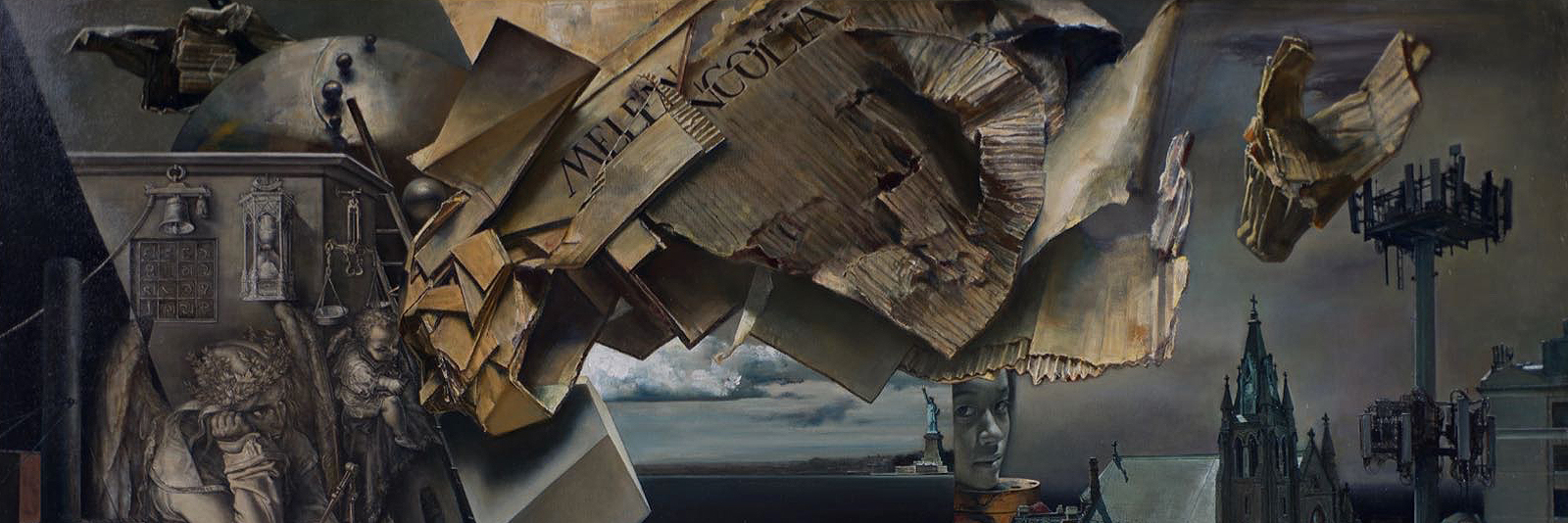
Indeed, to look at Red Hook Fantasy, his recently completed, and quite magnificent, self-portrait, is to see not only the dignity of the sitter, but also the very surroundings and structures just outside his windows. The factories, the Gothic Revival Catholic church on the corner, the same roof from which he first admired that panorama, the noirish alleyways of Red Hook – all appear as the backdrop to the artist in his paint-smeared smock. Hovering over this scene – which is decidedly urban and also jarringly post-apocalyptic – is the painted word Melencolia. This references yet another historic master who has influenced Wang: Albrecht Dürer. “I love this word because it evokes the artist’s ‘loneliness,’ which I experienced myself, especially during the Cultural Revolution.”
Wang opens a sketchbook containing some early iterations and ideas for the self-portrait. Page after detailed page reveals a figure, hovering almost angel-like in the background next to him. Asked about that shadowy figure, Wang replies, “That is Gustav Mahler. I am crazy about Mahler. I wanted to include, somehow, in a self-portrait because his music is so important to me.” Recognizing, finally, that he was forcing that image onto the canvas in ways that did not feel right, Wang ceded control and instead included an overt reference to Dürer, who represents, perhaps, a more direct artistic bond. Wang’s self-portrait now includes a version of Dürer’s angel from the master’s famous engraving Melencolia I.
ANOTHER PALETTE
In addition to his palette of pigments, Wang works with a musical palette. Whether it’s a recording of Wagner’s Parsifal, a Shostakovich symphony, or, most often, Mahler’s Titan symphony, music accompanies every one of his brushstrokes. “Why Mahler?” Wang asks rhetorically. “Because Mahler is always thinking about the human condition, about philosophy, about religion, about nature, about the meaning of life.”
To further emphasize this musical bond, Wang goes to a corner of his studio and pulls out a canvas that shows a humble house, situated at the end of a long expanse of dense green woods. “This is Mahler’s house in Austria, which I went to see. He had no motherland, really. He was Jewish in a world hostile to Jews. He was always in search of a home, never at home. Even in China, you go from village to village and a person’s accent is different. It marks them as an outsider. I still feel like an outsider, too.”
But feeling like an outsider has advantages for an artist, as it heightens one’s powers of observation. Wang continues to express awe at the people he has met through both serendipity and introductions. One of his most notable models is the Harvard-based scholar Henry Louis Gates, Jr., whom he has painted three times; the most formal version hangs at the National Portrait Gallery in Washington.
Wang points next to a large canvas in progress that depicts a beautiful, discreetly nude woman. He was introduced to the sitter, Charlotte de Broglie, by a neighbor who thought she might make a good mode. “It turns out she’s a French princess, the real thing,” Wang explains. When she visited his studio days later and saw Wang’s completed canvases, she was the one to offer herself as a model. “She sat for me four or five times. She stated that she couldn’t commission a portrait, but she did hint that once it was complete, maybe her father would buy it!”
In his large portraits, Wang paints not only his sitters’ likenesses, but also their histories. Just as he did with his self-portrait and that of Gates, he has included motifs that reference the princess’s life – for examples, an image of Ingres’s 1851 portrait at the Metropolitan Museum of Art depicting the Princess de Broglie. “That is her direct ancestor,” says Wang, pointing to the woman in a shimmering blue gown he has eerily recreated. Also depicted is another relative of the princess, a man who won a Nobel prize in physics. Today the young princess’s gown, trimmed in what appears to be chinchilla, hangs beside the canvas, ready to be worn should she return for another sitting.
Wang continues to study his self-portrait, which he gave himself as a kind of birthday present. While painting it last year, he suffered a serious gallstone attack during which, he says, he “kissed death.” That episode, coupled with world events that have led him to despair – everything from the current U.S. president to Brexit to the European refugee crisis – is what led him to inscribe Melencolia on the canvas.
“One day, I walked to the end of the Louis Valentino Pier, here in Red Hook, and I looked across the water to the Statue of Liberty. I asked myself, ‘What is the value of life? Why am I here?’” By the time he returned to his studio, he knew the answer. “I’m here to be an artist, and every artist’s mission is to speak out.”
Having described this episode, Wang shifts to a cozy seating area in his studio, furnished with a couch and floor-to-ceiling shelves filled with CDs and LPs. He pulls out a vintage LP and puts on Wagner’s Parsifal, the tale of a man’s quest to find the Holy Grail. “Bach, Mahler, Wagner – they help me find the entrance to my soul,” Wang says as the needle drops.
Surveying the many canvases in Wang’s studio, as well as those in private and public collections, it is clear that Wang has found his soul and is sharing it with the world.
David Masello is an essayist on art and culture, a poet, and playwright who lives and works in New York.
一个肖像画家的肖像
《艺术行家》2019 第1期 大卫·马塞洛(美)
王玉琦(生于1958年)正在试图寻找一个合适的词……在他的莱德霍克(布鲁克林)画室的留声机上,播放着名的意大利男高音歌唱家弗兰克·科莱里的唱片。一束阳光,从西向的大窗射投射进来。这是一个安静与沉思的空间。 “在我的肖像画中,我试图捕捉一些关于人,人性深处,那种属于精神的东西…..但这些,依然还不是我准确描述自己的肖像画的关键词。” 王说这些话的同时,指着竖立在周边的那些画布。虽然玉琦(发音为“Yoo-chee”)在中国出生和成长,但他能说流利的英语,尽管有口音。但相较其执拗的意图,他边讲边搜索着在线的汉英词典。
“啊,有了,” 他说着,并用iPhone显示出现在英中双语字符中的答案。 “‘Dignity’ ——‘尊严’,这就是我希望通过绘画,来赋予在我面前的任何人所应有的品质;他们的尊严。”
看着王的阁楼式工作室的墙壁和画架上那许多的面孔和身体·,他所描绘的独具尊严的男人女人,着衣或裸露,虽然大多数都展示出漂亮的生物属性,但有些却也更加坦率地曝露出TA们的年龄。鉴于他的特定主题,伦勃朗作为最重要的影响一点都不意外。
“伦勃朗试图寻找一个人的内心世界,并把它投射到画布上,”王说。 “他画人,是的。但他并不总是寻找漂亮的脸或漂亮的形体。他所塑造的形象,看起来像海上的灯塔。你看到的是真实的人。早年,作为一个中国男孩儿, 当我从艺术史书中第一次看到伦勃朗的画作,即被深深感动。那时,我并不了解所谓西方艺术或东方艺术。他所画的人物之于我,就是作为人的自己。这对我来说很重要。”
王的成长初期,正值中国发生“文化大革命”,迫使人们隔绝了西方的所有事物,无论是政治还是美学。典型的例子是,大概是他10岁或11岁,有一次在学校老师的窗户上, 看到用来糊窗户的发黄的旧报纸上,有一副黑白图片。他停下来,好奇地走到窗下,盯着那个长发和神秘表情的人物形象:“嗯,外国男人。” 多少年后才知道,那是他第一次看到莱昂纳多达芬奇的《蒙娜丽莎》。 “我当时没有关于西方艺术的概念,但我无法停止寻找,即使脸对我来说有点吓人。”
后来,在高中毕业之后,他逐渐看到了更多关于西方艺术的范例。尤其是20世纪70年代末,法国奥塞博物馆十九世纪藏品在北京的展览,为王先生提供了一个坚实的背景。从那时起,他的主题表现,有了前进的方向。他被夏尔丹,米勒,库尔贝等巴比松画派作为艺术家和运动之一的作品所吸引,帮助他塑造了自己的艺术身份。再后来,是莫里罗和沃特豪斯。 “即便在今天,我一直在思考拉斐尔前派的艺术家,以及他们作品的强大影响。我在美院毕业后,作为赠送朋友的礼物,临摹过沃特豪斯《船上沙洛特夫人船上》 的红头发女人——那种传说中死于单相思的爱情中的人物,以及莫里罗的《莎乐美》。
一个早期的革命
今天,王是世界公认的肖像画大师之一,赢得了许多奖项以及著名的公共肖像定制,包括美国肖像协会的大奖和一等奖,以及国家肖像画廊Outwin Boochever竞赛的二等奖。
王以肖像绘画助其蜚声画坛,实际上并不曾是他作为一名年轻艺术家所追求的梦想。当他考入自己出生的城市天津美术学院时,所学专业是版画。 “在那些日子里,四年,版画是必须学习的东西。没有人可以违反规则。但是, 在进行毕业创作的最后一年,我坚持要画油画。从而被警告说:如果我固执己见,最终可能不会得到毕业证书。”
那是一种真正的革命精神。“早熟”的王无视校方要求。在他的毕业创作中,他画了一系列描绘中国乡村生活的油画,这在很多方面与19世纪法国田园风光相呼应。结果, “我必须承认,我在校园里成了一名明星,”他回忆道。
随后,他更是主动放弃了鲜艳明亮的红色。王描绘了一幅农民收工回家的场景 —— 一个男人和一个女人,来自田野,肮脏而疲惫,但作为劳动者的高贵。这件作品最终为他赢得了全国性的奖项。 “那幅画是昏暗的,颜色很柔和; 中国的绘画多年来一直没有那么现实。“
后来,王先生进入北京的中央美术学院油画系继续学习。在那里,他终于有机会获得足够的快感,体验到油画模特写生训练的魅力,并尽可能保持着这种技巧的运用。以真实感受与激情为依据来描绘真实的人与生活,王又开始了一组由五幅作品构成的女性主题系列作品。 “我在乡村偶遇一个小女孩参加葬礼归来,远远地看到她一袭白色麻质丧服。无论是她的穿着,还是她脸上的表情,都强烈地触动到我。” 正是那种记忆,王描绘了一个女人象征性的完整生活——从少女到年迈的不同人生阶段。
他从一个喜欢写写画画的小孩儿,成长为一个可以描绘任何东西的艺术学生,再到后来成为一名艺术教师,王懂得选择正确主题的重要性。而一个好的画家,今天更可以说一位伟大的画家——尤其作为一个肖像画家,需要获得被描绘者的信任。作为模特——无论是他或她,尤其需要通过艺术家的独特视角与构图设计,来了解将要成为画作中的自己。画家通常需要见到他的模特,并以写生作为素材;一般不少于3-4天。当然,多多益善。
“文化大革命的灾难岁月,作为一个男孩儿,绘画教会了我保卫自己尊严的方式。”王解释道。 “我会非常小心地寻找不仅对我友好、且愿意坐下来让我画画的人。我最初的模特,常常是家庭成员、邻居,或者是同学。”
尽管中国在20世纪90年代中期,已经成为一个非常不同以往的地方,但王渴望着一个更具崭新蕴涵的生活出现在他的画布上。已经在美定居的中国友人鼓励他来到芝加哥。 “我决定去芝加哥有几个原因,”王回忆说, “首先,我在巴黎的奥赛博物馆,看到了一些古斯塔夫·莫罗表现神话场景的作品。而我最喜欢的一幅《赫拉克勒斯屠龙》的作品,居然是芝加哥艺术学院博物馆的永久收藏。我还希望看到乔治·索尔蒂爵士指挥芝加哥交响乐团;看看迈克尔·乔丹打篮球;还有,也许是第四个原因:传说“意大利黑手党”在那儿曾经拥有过强大的力量。” 虽然,芝加哥被证明是他进入美国生活的不错的门户,但王渴望东部,感受纽约的喧嚣。最终,他搬到那里。如今,每天他都往返穿梭于位于布鲁克林的公寓和附近的工作室之间。
王先生记得他第一次游览莱德霍克地区粗犷的后工业景观; 他了解到那里的旧厂房的光线和低廉的租金对于艺术家来说是理想的。 “房东把我带到了这栋建筑的屋顶。当我看到那里的360度全景 – 曼哈顿和布鲁克林尽收眼底;自由女神像在教堂和一些工厂之间的缝隙中远远地窥视 -——我想,这个环境说不定有一天会成为我的主题。”
事实上,看看《莱德霍克的幻想》——他最近完成的,非常华丽的自画像,不仅看到了主人公的尊严,还要看到窗外的环境和空间结构。工厂,拐角处的哥特式复兴天主教堂,与他第一次观察所获得的那个全景中的同一个屋顶,红钩紧邻的小巷 ——这些都成为了艺术家与他皴擦染沾着颜色的意大利文艺复兴式的画袍的背景。徘徊在这个场景 -——绝对是一座城池,却因极度的不和谐而愈显震撼人心的后世界末日 ——然后,“Melencolia”(忧郁)赫然飘扬,或坠落,如旗障目!这里的引用,来自于另一位影响王至深的历史绘画大师:Albrecht Dürer。(阿尔布莱特 ·丢勒) “我喜欢这个词。因为它唤起我所经历的作为艺术家的 ‘孤独’;特别是在文化大革命期间。”
王打开他的速写本,其中包含这件作品的草图——一些初始的自画像与更迭的想法。详细翻看几页之后,发现在他旁边的背景中,有一个似是天使又像幽灵般盘旋的影子。当被问及这个阴暗的人物时,王回答说:“那就是古斯塔夫·马勒。我对马勒很着迷。我想以某种方式将自画像包括在内,因为他的音乐对我来说非常重要。” 但到最后,他感觉到有些过于勉强这幅画了,所以王还是不情愿地放弃了。代之而来的,是包含了一个更为醒目的丢勒——他或许是一种更为直接的艺术纽带。现在我们看到的,是王在这幅自画像中,包括了来自大师丢勒著名的蚀刻版画 “Melencolia ” 中的忧郁的天使。
另一个调色板
除了他的颜料调色板外,王还有一个音乐调色板。无论是唱片如瓦格纳的歌剧《帕西法尔》,肖斯塔科维奇的交响曲,还是最常见的马勒《巨人交响曲》,等等。音乐,伴随着他的每一个笔触。 “为什么选择马勒?”王先生反问道, “因为马勒总是在思考人类的生存状况,关于哲学,关于宗教,关于自然,关于生命的意义。”
为了进一步强调这种与音乐的联系,王走到他工作室的一角,拿出一幅小画,画中展示了一座简陋的房子,位于一片茂密的绿色森林的尽头。 “这是马勒在奥地利乡间的作曲小屋,我去看了,现场画回来的。他真的没有祖国。在波西米亚,一个敌视犹太人的世界里,他是犹太人。他总是在寻找一个家,却从未所归。我个人的经验中,即使在中国,从一个村庄到另一个村庄,口音也不尽相同;我总被人们称为“外庄子”——一个局外人。就算是现在,我仍然觉得自己像是一个局外人。“
然而,“局外人” 的感觉对艺术家有好处,因为它提升了一个人的观察力。王继续严苛地拣选并叙述他通过介绍或偶然机会所相识的人。他最着名的模特之一,是哈佛大学的学者亨利·路易斯·盖茨(Henry Louis Gates,Jr。);他已经画了三次。 最正式的版本挂在华盛顿的国家肖像画廊。
王站在一幅正在进行中的大型画布旁边:一幅美丽、矜持的裸体女人。当时,他被一位邻居,也是艺术学生介绍给夏洛特·德布罗伊——她愿意为你做模特。 “事实证明:她是法国公主,真实的公主。”王解释道。随后,当她访问他的工作室,并看到王的作品画册,她欣然成为了他的模特。 “她为我坐了四五次。她说:这不是委托定制;是我情愿为自己喜欢的画家服务。但她确曾暗示,一旦完成,也许她父亲会买它!”
在他绘制的大量的肖像作品中,王不仅描绘了TA们形相上的“肖似”,也是在叙述TA们的历史。正如他对自画像和盖茨的画像一样,他也会参考与公主生活有关的图片——例如:安格尔1851年绘制的《公主德布罗伊》肖像之于纽约大都会博物馆 ,相当于《蒙娜丽莎》之于卢浮宫——“这是她的姑奶奶,直系祖先。”王指着画册中那位穿着闪亮蓝色礼服的女人说道。他的重新创作很诡谲;并且,还描绘了公主的另一位亲戚,一位获得诺贝尔物理学奖的人。直到今天,年轻公主的一件皮草坎肩,看似是栗鼠,依然挂在画布旁边,像是她随时回来坐着就准备穿起来……
王继续审视着他的自画像,曾把它作为送给自己的一件60岁的生日礼物。去年,就在他画此画期间,他遭受了严重的胆石症袭击;用他自己的话:几乎 “亲吻了死亡。” 同时,发生在周边世界此起彼伏的社会事件,令他倍感绝望——从美国总统大选到英国脱欧,再到欧洲难民危机 ——所有这些,都直接导致他在画布上“刻下”了 “Melencolia。”
“有一天,我走到时常光顾的路易斯·华伦天奴小码头顶端,从“红勾”这一侧,注视着水对面的自由女神像。我问自己:’生命的价值是什么?我为什么还呆在这儿?” 但当他回到自己的工作室,他知道了答案: “我在这里,只因为是一名艺术家;每个身为艺术家的使命,就是把心里的话说出来。”
描述到此一段落,王转身走到他工作室一角舒适的休息区,配有沙发和落地式书架,里面装满了CD和LP。他拿出一张老式LP——瓦格纳的《帕西法尔》——这是一个男人寻找圣杯的故事。 “巴赫,马勒,瓦格纳 ——他们帮助我找到灵魂的入口,”王说着,唱针落下。
对王的工作室的访问,以及私人和公共收藏中诸多作品的深入了解,显然,王找到了自己的灵魂,并将其与世界分享。